

Team Leaderboard Ideas That Motivate Without Embarrassing Anyone

The best team leaderboards rank teams or pods rather than individuals, track behaviors people can influence (participation, recognition, learning, small wins), reset every month or so, and compare people with their own past results as much as with each other. Below are 15 concrete ideas, a way to score them fairly, and a short plan for launching one with a remote or hybrid team.
TL;DR
- Rank small teams or pods against each other, and show individuals their own progress, so nobody sits alone at the bottom of a public list.
- Track more than sales: daily challenges, recognition given, training completed, meeting participation and wellness goals all work.
- Use weighted points so different roles can compete fairly, and keep the rules on one page.
- Reset monthly, update scores on a fixed rhythm, and pair rankings with small, meaningful rewards.
- Measure the effect with a baseline survey and a weekly participation read, not gut feeling.
Table of Contents
- What a team leaderboard is, and why it works for distributed teams
- Choose the frame first: individuals, pods or personal bests
- 15 team leaderboard ideas you can launch this month
- Score fairly across roles and levels
- Keep it motivating, not shaming
- Display, update and reset the board
- Rewards that fit a small-stakes game
- Perspective: why we think the leaderboard should be a daily habit
- Launch and measure: a four-week plan for HR and team leaders
- Run your leaderboard on Gatherilla
- FAQ
- Sources
What a team leaderboard is, and why it works for distributed teams
A team leaderboard is a live ranking of teams or people based on points, results or participation. One 2026 guide to employee leaderboards describes the purpose as turning scattered data into one signal employees can check without asking their manager. When individual scores roll up into a team total, people have a reason to help each other, and managers get a week-to-week read on who is taking part.
That last point matters most for remote and hybrid teams. In an office, participation is visible: you see who joins the lunch quiz or stays for the retro. On a distributed team, a leaderboard is often the only visible trace of shared activity. Done well, it replaces the “is anyone even playing?” question with a number everyone can see.
Done badly, it does the opposite. Which brings us to the one design rule that decides whether a leaderboard helps or hurts: choose the frame before you choose the software.
Choose the frame first: individuals, pods or personal bests
There are three basic frames, and most good boards blend two of them.
| Frame | What it ranks | Best for | Watch out for |
|---|---|---|---|
| Individual | Each person against everyone | Short sprints among peers in the same role | Bottom-of-list embarrassment, less collaboration |
| Team or pod | Groups of 3 to 6 against each other | Mixed roles, onboarding cohorts, company-wide events | Free riders if scoring is only the total |
| Personal best | Each person against their own past | Learning, wellness, habit-building | Less excitement unless paired with a team goal |
Research summaries from the field back the blend. One 2026 sales motivation guide notes that team boards reward collaboration while individual boards sharpen competition but weaken collaboration, and suggests splitting a team into small pods and racing the pods. A pod also cushions a slow week: one person’s dip is absorbed by the group average.
A wellness-gamification review makes the same point from another angle: it recommends avoiding open rankings that leave people embarrassed at the bottom, and using team challenges or personal-best tracking instead.
Our default advice: rank pods publicly, show individuals only their own trend line, and celebrate the top of the board rather than listing the bottom.
15 team leaderboard ideas you can launch this month
Ideas built on daily play
- Daily challenge streaks. Teams earn a point each time every member completes the day’s word or trivia challenge. The board ranks the longest active team streak. It takes about two minutes a day and builds a habit.
- Pod trivia league. Split the company into pods of four or five and run a short trivia round before each weekly all-hands. Total points per pod go on a season board.
- Icebreaker MVP. Give a point for each icebreaker a person hosts or answers in a meeting. Rotate the host so quiet teammates are not left out.
- Cross-team head-to-head. Pair two teams from different time zones for a one-week game duel. Head-to-head challenges help remote coworkers get to know each other, especially when they live in different states or cities.
Ideas built on connection and recognition
- Giving leaderboard. Rank people by how often they recognize others, not by how often they are recognized. In one vendor study, teams that displayed only a giving board saw 25% more recognition per person each month than teams with no board. The same research warns that boards are not neutral: a board ranking people by recognition received can reduce helping behavior. The metric you pick shapes behavior.
- Values board. Tie each recognition to a company value and rank values, not people. Leaders see which values are alive in daily work.
- Welcome squad score. For new hires, give the buddy pod points for completed first-week activities: a coffee chat, a game session, a team question answered.
- Kudos chain. Count the longest chain of thank-yous that passes through every team. The goal is a shared record, not a winner.
Ideas built on work and learning
- Learning sprint. Points for completed trainings, quiz scores or knowledge-share sessions, tallied per team over a month.
- Customer satisfaction pods. Support and success teams compete on satisfaction scores against a target, not against each other’s individual numbers.
- Process improvement board. One point per documented fix, automation or template that saves the team time. Great for operations groups.
- Meeting punctuality and participation. Teams earn points for starting on time and for everyone contributing to a check-in. Keep this light and optional; it works as a game, not as surveillance.
Ideas built on wellness and community
- Steps or movement challenge. Teams pool steps or active minutes. Pair it with a personal-best view for anyone who prefers not to be compared.
- Volunteer hours. Teams log volunteering time, and the board shows the total for the company, with a pod ranking as a bonus.
- Sales or revenue board, done carefully. For sales teams, rank pods against a shared target and include leading activities, not only closed deals (see scoring below).
More formats are in our guide to friendly competition ideas at work, and our gamification playbook for remote teams covers how to mix them.
Score fairly across roles and levels
The fastest way to kill a leaderboard is to rank an engineer and a recruiter on the same raw number. Use points instead.
A weighted system gives each activity a value and ranks on the total. One example from a guide to weighted sales leaderboards assigns 10 points to a closed-won deal, 5 to a qualified opportunity, 3 to a booked demo and 1 to a logged call, so the board rewards the whole mix of behavior rather than one metric.
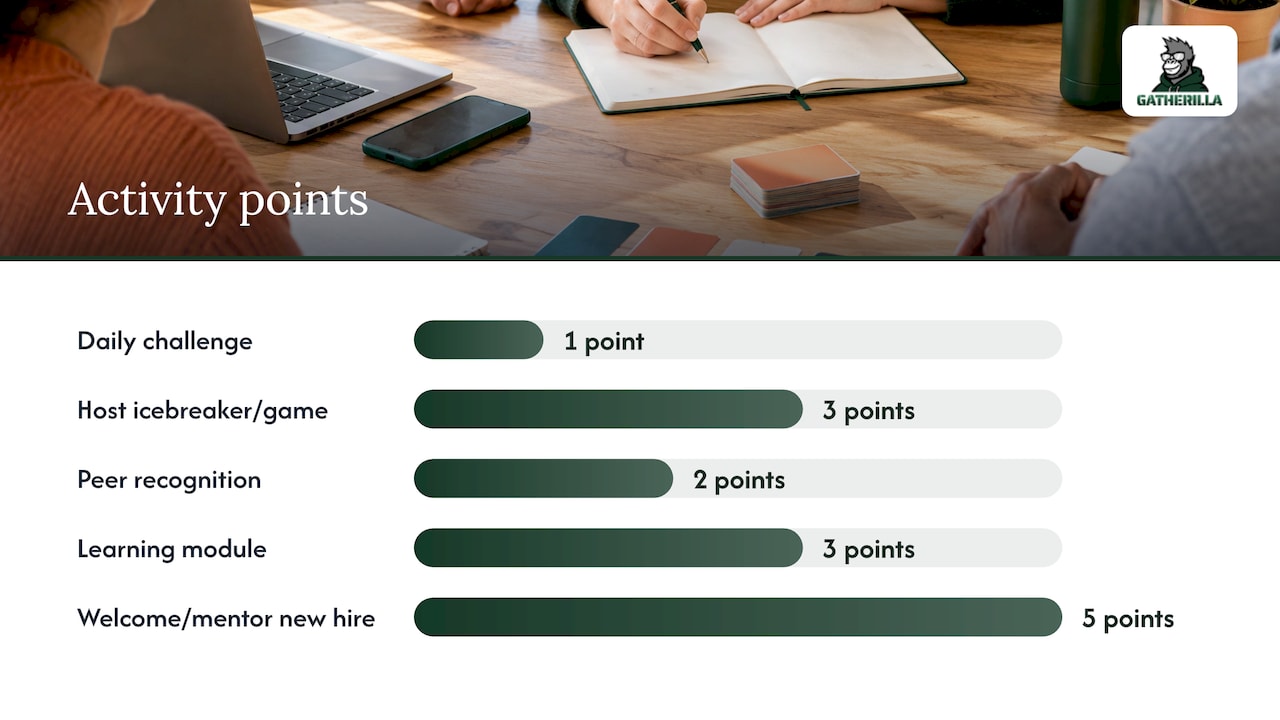
For a general team, the same logic looks like this:
| Activity | Points | Why |
|---|---|---|
| Complete the daily challenge | 1 | Low barrier, rewards showing up |
| Host an icebreaker or game | 3 | Rewards organizing |
| Give a peer recognition tied to a value | 2 | Rewards helping others |
| Finish a learning module | 3 | Rewards growth |
| Welcome or mentor a new hire | 5 | Rewards the work that is hardest to see |
Some rules keep it honest:
- Cap daily points. Otherwise the most online person wins by volume.
- Normalize by team size. Rank pods on average points per person, so a five-person pod competes fairly with a three-person pod.
- Compare like with like. Put new hires in their own cohort for the first weeks.
- Write the rules on one page and share them before the first round. People accept a loss more easily when the rules were visible from the start.
- Include a personal-best view so someone who is improving feels progress even when the pod is not first.
Our single-list team points system guide goes deeper on keeping points in one place for distributed teams.
Keep it motivating, not shaming
A critique of leaderboards on psychological safety argues for switching from ranking people against peers to measuring each person against their own past and teams against goals. We would add a few practical guardrails:
- Show the top three or top pod, not the full individual list.
- Make participation voluntary for anything tied to work output.
- Reward effort and consistency as well as results, for example a “most improved” title.
- Do not link a leaderboard to pay, promotion or performance reviews. A leading recognition study quotes a researcher saying recognition, financial incentives and culture programs must fit together or they undermine each other.
- Keep the stakes small and the tone playful.
Display, update and reset the board
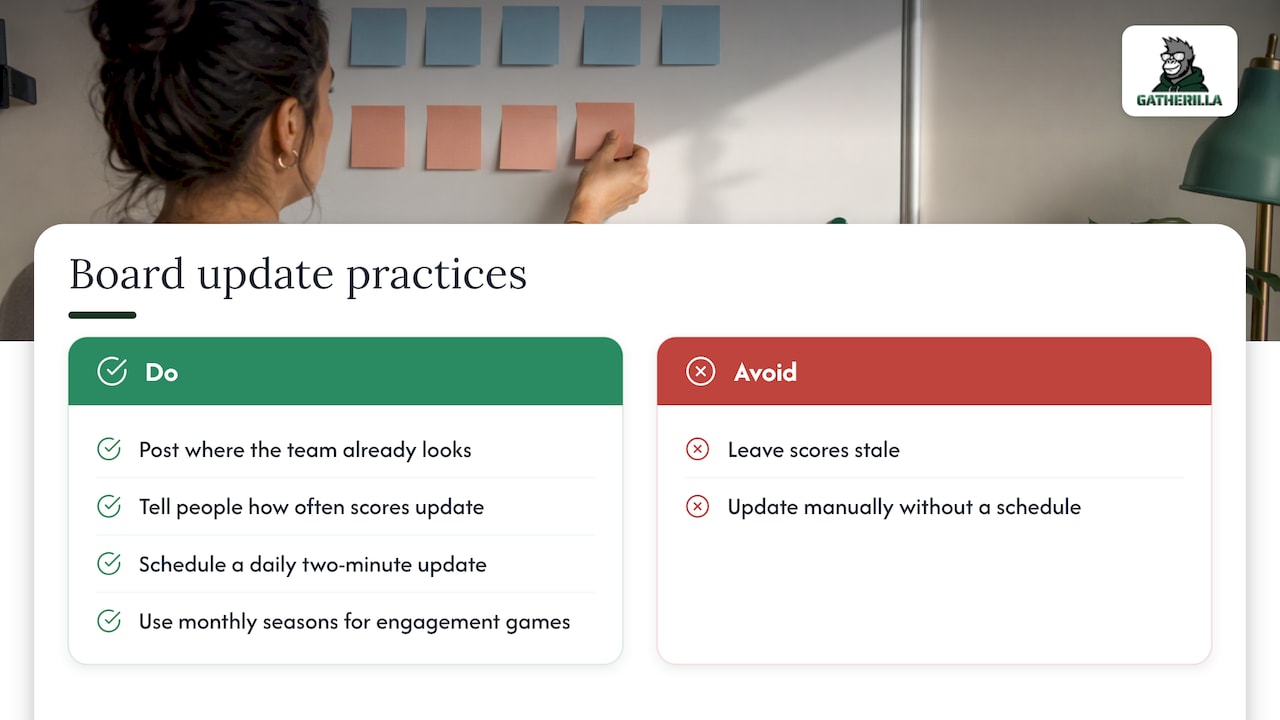
Display the board where the team already looks: a pinned channel, the meeting screen, a weekly email or an office display for hybrid teams. Whatever you pick, tell people how often scores update.
Cadence matters. A leaderboard setup guide calls monthly resets the sweet spot for most sales teams: short enough that one strong week can change the standings, long enough that results reflect effort rather than luck. Quarterly suits longer cycles, weekly suits high-volume work. For engagement games, we recommend monthly seasons with a short break between them.
The same guide warns that a board with stale scores is worse than none, because it signals that nobody cares. If scores update automatically, you avoid the problem. If they do not, schedule a two-minute update at the end of each day.
For digital tools that turn scattered numbers into visible progress, AI-assisted performance tracking can help analysts consolidate work metrics before they reach a board.
Rewards that fit a small-stakes game
Rewards should say “thanks” rather than “buy performance.” A 2025 sales gamification guide groups successful rewards into financial incentives, recognition (trophies, certificates, public acknowledgment), experience prizes, professional development and time rewards such as an early finish.
For remote teams, these tend to work best:
- A shout-out at the all-hands and a rotating “champion pod” title
- A learning budget or conference slot for a season winner
- An extra hour off on a Friday
- Choosing the next team game or theme
- Company swag shipped to the winning pod
If you want more options, our list of employee recognition ideas has 50.
Perspective: why we think the leaderboard should be a daily habit
We have seen many leaderboards launch with a bang and die within a quarter. The pattern is almost always the same: a big event, a spreadsheet nobody wants to update, and a ranking that only the same three people care about.
Our view is that engagement works as a daily habit, not an occasional event. That is why Gatherilla is built around zero-preparation games that run in the browser, with no downloads and no accounts needed to join, plus a daily challenge that gives a team a reason to show up every day. The leaderboard is a byproduct of play, not an extra chore for a manager.
We also think recognition belongs next to the scores. Peer-to-peer recognition aligned to company values turns a points table into a record of what your culture actually rewards.
Start small: one pod league, one month, one page of rules. If people are still asking for the next round, you have a habit worth building on.
Thomas
Launch and measure: a four-week plan for HR and team leaders
- Week 0: baseline. Before launch, capture a baseline with a short pulse survey or listening conversations. One engagement program guide recommends baselining with surveys, pulse checks, listening groups and exit interviews, then tracking targets, leading indicators and a review rhythm.
- Week 1: announce and pod up. Share the one-page rules, create mixed-role pods and run a practice round.
- Weeks 2 to 3: play daily. Post a short standings update at the same time each week. Highlight a surprising win or a pod that rallied.
- Week 4: close the season. Announce the champion, share one story per pod and run the same pulse questions.
Watch participation rate (share of people who played at least three days a week), recognitions given per person, and how many pods stay active. A 2026 recognition benchmark report found teams with a weekly recognition ritual averaged about one recognition per member per month, against one every two and a half months without it, so a weekly rhythm is worth building into the board. Our engagement games guide for HR lays out what to expect over six weeks, and our team engagement guide covers how to keep it going.
Run your leaderboard on Gatherilla
Gatherilla is a browser-based platform for remote and hybrid teams: customizable multiplayer games, daily word and trivia challenges, icebreakers, onboarding games and real-time leaderboards, with no downloads, working alongside any video conferencing tool. The Free plan lets you try it with your team. Premium adds more games, reporting and priority support, at $0.50 to $1.00 per seat per month or $5 to $10 per seat per year, as published on our pricing page.
If you want a pod league running by next week, start with Gatherilla’s team games and set up your first round in minutes.
FAQ
What should a team leaderboard track besides sales?
Almost any behavior you want more of: recognition given, daily challenge participation, training or quiz completion, team activities, attendance, wellness goals such as steps, and customer satisfaction. One company leaderboard guide lists these same categories. Pick two or three, not ten.
How often should a leaderboard reset?
Monthly works for most teams, because a strong week can still change the standings. Use weekly resets for fast, high-volume work and quarterly for long cycles. Whatever you choose, state the cadence in your rules.
How do I stop a leaderboard from demotivating people at the bottom?
Rank pods instead of individuals, show people their own progress, and celebrate the top rather than publishing the bottom. Keep participation voluntary and the rewards small. Compare people against their own past results whenever you can.
Are leaderboards a good fit for onboarding?
Yes, if new hires compete in a cohort of their own or earn points as part of a pod with a buddy. Score welcoming actions such as coffee chats, game sessions and first-week tasks rather than output. The goal is connection in the first weeks, not ranking.
Sources
- Employee Leaderboard: Types, Benefits & Best Practices
- Build a sales leaderboard that motivates
- Common Gamification Mistakes in Wellness
- Leaderboard Strategies for Remote Workforces
- Designing Peer Recognition for Engagement
- Why a Single-Metric Leaderboard Backfires
- The Bottom Rung: How Leaderboards Kill Psychological Safety
- Sales Rep Leaderboard TV Display: Complete Setup Guide
- AI Product Performance Tracking for Analysts and Teams
- Gamification in Sales
- Design Employee Engagement Programs That Work
- 2026 Employee Recognition Benchmark Report
- How To Use A Company Leaderboard To Improve Employee Engagement