

Developer Team Icebreakers: 25 Ideas Engineers Will Actually Use

The best developer team icebreakers are short, tied to the work engineers already know, and optional to answer. Think “the bug that taught you the most” instead of “share a fun fact about yourself.” Keep them to three to five minutes, make them easy to join from any seat or screen, and run them at the start of a meeting rather than as a separate event. For remote and hybrid teams, a browser-based game that needs no downloads and works on any video call, like the ones in Gatherilla, takes the setup off the facilitator.
This guide gives you ready-to-run questions, quick activities, remote and hybrid formats, onboarding ideas for new developers, and a way to scale each one to your group size.
TL;DR
- Engineers respond to icebreakers with a story and a technical hook: outages, bugs, tools, shortcuts. Skip generic “what do you do” prompts.
- Run them in the first five minutes of a meeting, when people are most likely to speak up, and keep them to 3 to 5 minutes.
- In hybrid meetings, give everyone the same input channel (chat, poll or browser game) so remote people are not spectators.
- For new hires, use small groups and low-stakes prompts. Save deeper personal questions for later.
- A daily or weekly habit beats a one-off event. Free and low-cost tools can run it for you.
Table of Contents
- Why generic icebreakers fail with engineers
- Icebreaker questions developers like answering
- Five-minute activities for developer meetings
- Remote and hybrid developer teams
- Icebreakers for onboarding new developers
- Fitting the icebreaker to group size and meeting length
- Keep it low-pressure and psychologically safe
- Make it a habit with Gatherilla
- FAQ
- Sources
Why generic icebreakers fail with engineers
Most icebreaker lists are written for sales floors and classrooms. Ask a room of developers to “name your spirit animal” and you get polite silence. The problem is rarely that engineers dislike connecting with colleagues. It is that the prompt has no point of entry. There is nothing to be right or interesting about.
The timing logic is still sound. Atlassian’s Team Playbook recommends icebreakers in the first five minutes of a meeting, citing Susan Cain’s argument in Quiet that people who do not speak early are less likely to speak at all. For a stand-up, retro or design review, that matters: the quiet engineer with the best objection is exactly the one who needs an easy first turn.
Three rules fix most failures:
- Use the shared context. Tools, languages, outages, code review, AI assistants and keyboard shortcuts are common ground. Everyone has an opinion.
- Make it brief. Three to five minutes. If it needs a slide deck, it is a workshop.
- Make it optional. “Pass” should always be a valid answer.
Icebreaker questions developers like answering
A good question for engineers has a story inside it. EngineeringLeaders.io’s guidance on speed networking recommends this style and advises skipping yes/no questions and “what do you do” openers. Its examples include the biggest outage someone has been part of and what changed afterward, and what someone uses an AI coding assistant for and where it fails them.
Centercode’s list for product and dev teams adds quick, low-effort questions such as which tool saved you the most time this month, which browser tab you always keep open, and which keyboard shortcut you use most.
Here is a working set, grouped by how much time you have.
Thirty-second questions for stand-ups
- What browser tab is always open on your machine?
- Which keyboard shortcut do you use most?
- What tool saved you the most time this month?
- What is your go-to drink while coding?
- One word for your week so far.
Two-minute story questions for retros and planning
- What bug taught you a lasting lesson?
- What is the biggest outage you have been part of, and what changed after it?
- What do you use an AI coding assistant for, and where does it fail you?
- What piece of elegant code impressed you this year?
- If you could automate one part of your day, what would it be?
Debate-style questions for design discussions
- Tabs or spaces, and what would change your mind?
- Which tool would you keep, and which would you delete from the stack?
- What is the most overrated best practice you have ever followed?
Debate questions work because engineers enjoy defending a position. Keep the stakes low and the topics about taste, not about the team’s real architecture decisions, so nobody feels the icebreaker is a trap.
Five-minute activities for developer meetings
Questions are the fastest option. When you want a bit more play, these formats fit inside a standard meeting slot.
Rose, thorn, bud
Each person shares one good thing (rose), one challenge (thorn) and one thing they are looking forward to (bud). The Engineering Manager newsletter lists it among openers designed for engineering teams, alongside a blameless story about the best bug you caused and what you learned.
The blameless framing matters. Make it clear that the story is about learning, and go first yourself with a bug of your own.
Stick-figure architecture
Also from the same engineering list: everyone draws their system, or any system, as a stick figure in 60 seconds. It is silly, visual and surprisingly revealing about how people see the architecture. Share screens or hold drawings up to the camera.
Tool you couldn’t live without, tool you’d delete
Another opener from that list. Each person names one tool they depend on and one they would remove. It surfaces real friction in the workflow, which is a useful side effect for a team lead.
True or False, the engineer edition
In the classic version, each person makes three statements about themselves, one of them false, and the group votes on which is false. Atlassian describes it as a 10-minute game. For developers, make the statements about work history: “I once deployed to production on a Friday night,” “I wrote my first program in BASIC.” It keeps the game personal without getting too private.
Three Things
Also from Atlassian’s collection: one person names a category, the next names three things that fit it, and the group applauds before the next category. It takes 5 to 10 minutes. Try categories like “text editors,” “things that break on Mondays” or “words that appear in commit messages.”
Team timeline
Each person writes four important moments on slips of paper and adds them to a shared timeline on a wiki page or whiteboard. Atlassian rates it at about 15 minutes, so reserve it for a kickoff or offsite rather than a stand-up.
Remote and hybrid developer teams
Distributed engineers spend much of the day in text, so a spoken round of questions can feel like a sudden switch. Chat-based formats let people join in their own style.
Science of People’s list of virtual icebreakers includes several that run in under five minutes, among them:
- GIF war: post a GIF that matches a prompt such as “describe your week.”
- One-word weather report: describe your mood as a weather word.
- Thumbs up or down: quick votes on low-stakes topics.
- Sound check: describe the main sound you hear at your desk.
For engineers, adapt the prompts: “Describe this sprint as a Git command,” or “Which HTTP status code is your Monday?” Everyone types at once, so nobody waits for a turn and the loudest voice does not set the tone.
Making hybrid meetings fair
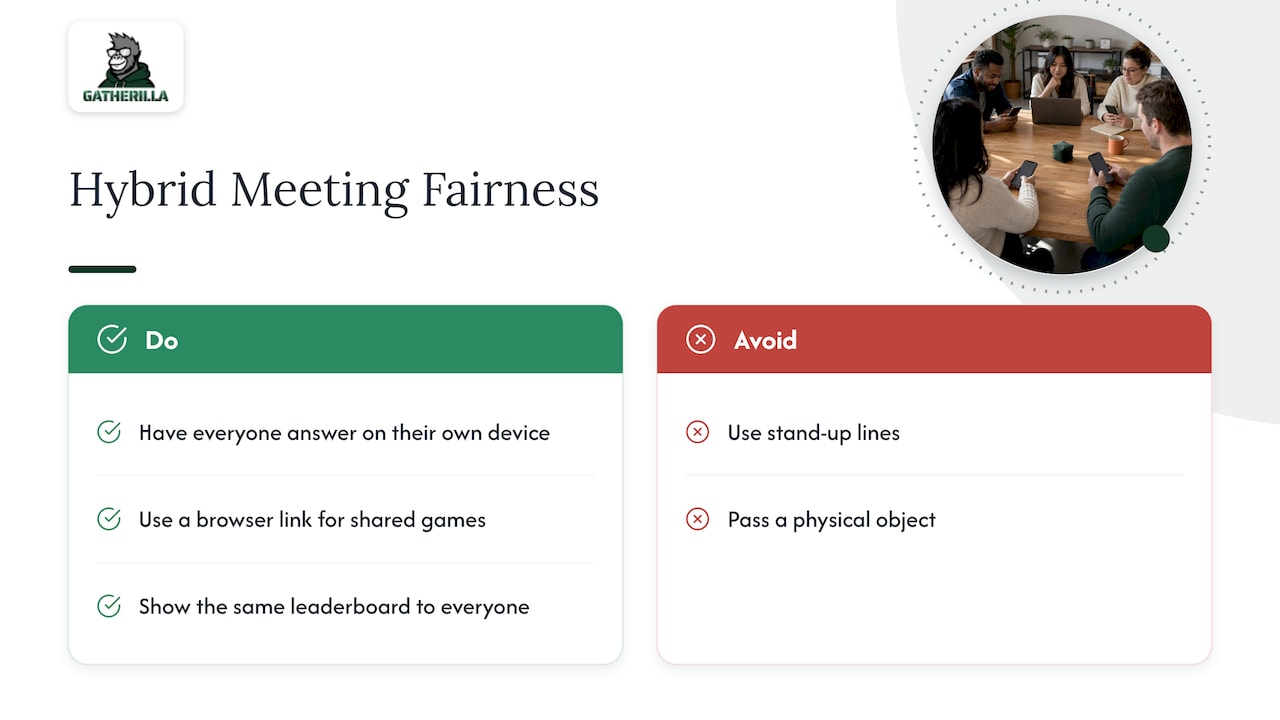
When some people sit in a conference room and others join by video, the room tends to dominate. A simple fix is to put everyone on the same channel: the people in the room answer on their own laptops, just like the remote people. Avoid anything physical, such as stand-up lines or passing an object, that excludes the people on screen.
This is where a browser-based game helps. Participants open a link, play on any device and see the same leaderboard whether they sit in the office or at home. Our guide to kickoff meeting games covers opening hybrid meetings in five minutes, and the no-prep meeting opener games are built to include everyone regardless of location.
If your team lives in chat, see our Slack icebreakers and Microsoft Teams icebreakers for formats that fit each tool. For a wider menu, the remote icebreaker games guide is a good starting point.
Icebreakers for onboarding new developers
A new engineer is absorbing a codebase, a toolchain and a dozen names at once. A heavy icebreaker adds to the load. The aim in week one is to make it easy to talk, not to extract personal stories.
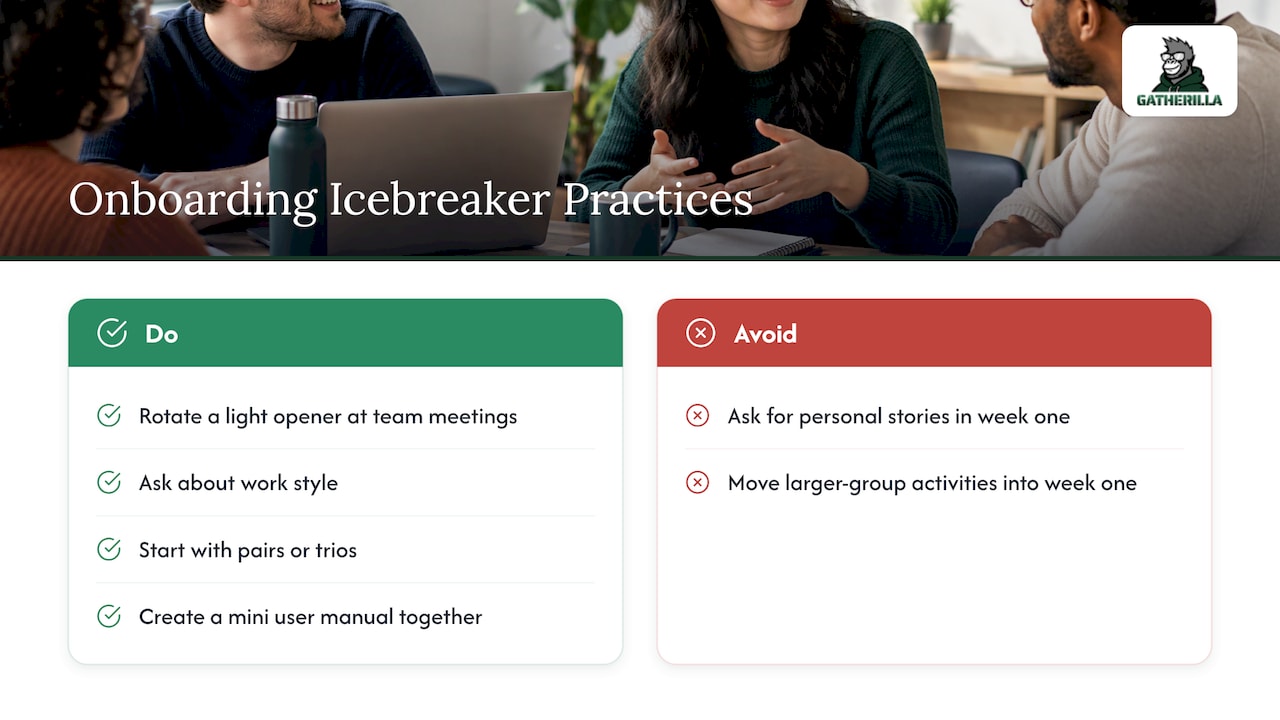
Rotate a light opener at every team meeting. Mattermost, a remote-first software company, describes kicking off each team meeting with rotating icebreakers so people share a little about themselves, alongside a Mentor for the Day program for new remote hires. The recurring rhythm does more than any single clever game, because the new hire sees how the team talks before they have to speak.
Pick questions about work style, not life story. “What do you use most in your editor?” is easy to answer. “Tell me about yourself” is not. A question like “What is one thing about how you work that is hard to explain but useful for others to know?” invites a real answer without being invasive.
Keep the group small. A circle of a dozen strangers is a lot of eyes on one person. Pairs or trios, such as a buddy, the manager and the new hire, are gentler. Move the larger group activities to the second or third week.
Add a mini user manual. Ask the new hire (and the existing team, so it is not one-sided) to write a short page on working hours, how they like feedback and what they need to do their best work. It turns an icebreaker into a working agreement.
Our list of new hire icebreakers has 30 more ideas for HR teams, and if you have just taken over a team, the new manager icebreakers cover your first meetings.
Fitting the icebreaker to group size and meeting length
The same activity can work or fail depending on how many people are present and how much time you have. Use this as a starting point.
| Situation | Time | Format that fits |
|---|---|---|
| Daily stand-up, 5 to 10 people | 30 to 60 seconds | One-word check-in, tab or shortcut question |
| Sprint planning or retro, 6 to 12 people | 3 to 5 minutes | Rose, thorn, bud; a bug story; three things |
| All-hands, 20+ people | 5 minutes | Chat-based poll or browser game with a shared leaderboard |
| Onboarding session | 10 minutes | Pairs or trios, then share one takeaway |
| Offsite or kickoff | 15 to 30 minutes | Team timeline, stick-figure architecture in small groups |
The logic behind the table:
- Under about six people, rounds where everyone speaks work fine. Atlassian’s Team Connectedness play uses round-robin questions and tells the team they can skip any question. For groups over six, it advises either extending the session to 90 minutes or cutting the question list to nine.
- Above ten or so, round-robin eats the meeting. Switch to simultaneous input: everyone types in chat, votes in a poll or plays at the same moment.
- When time is tight, cut the number of prompts, not the structure. One good question beats five rushed ones.
- In large groups, split into breakout rooms of three or four, give a two-minute prompt, and ask each group to report one surprising answer.
Keep it low-pressure and psychologically safe
Atlassian’s team explains that icebreakers such as True or False and Three Things work because they build psychological safety, a setting where colleagues feel free to speak up without fear of censure. They also recommend starting with simpler icebreakers for newer teams and avoiding overly personal or divisive topics.
In practice, for a developer team:
- Go first, and make your own answer a little self-deprecating.
- Keep technical debates about taste, not about the team’s real decisions.
- Never make participation a performance metric.
- Mix formats so quieter people have a way in: typing, polls and drawing as well as speaking.
Icebreakers are one piece of a bigger habit. If your goal is a team where people disagree openly in code review, these practical steps to build team trust pair well with a regular opener routine. For more structured exercises, see our online trust-building activities.
Make it a habit with Gatherilla
One-off icebreakers fade. Teams that connect tend to do it in small, repeated moments. Gatherilla is a browser-based platform for remote and hybrid teams: multiplayer games for team bonding, daily word and trivia challenges, icebreakers for meetings, onboarding games for new employees and real-time leaderboards. There is nothing to download, and it works with every video conferencing tool.
The free tier lets you try it with your team. Premium unlocks additional games, analytics and priority support, and is priced at $0.50 to $1.00 per seat per month, or $5 to $10 per seat per year, as published on our pricing page.
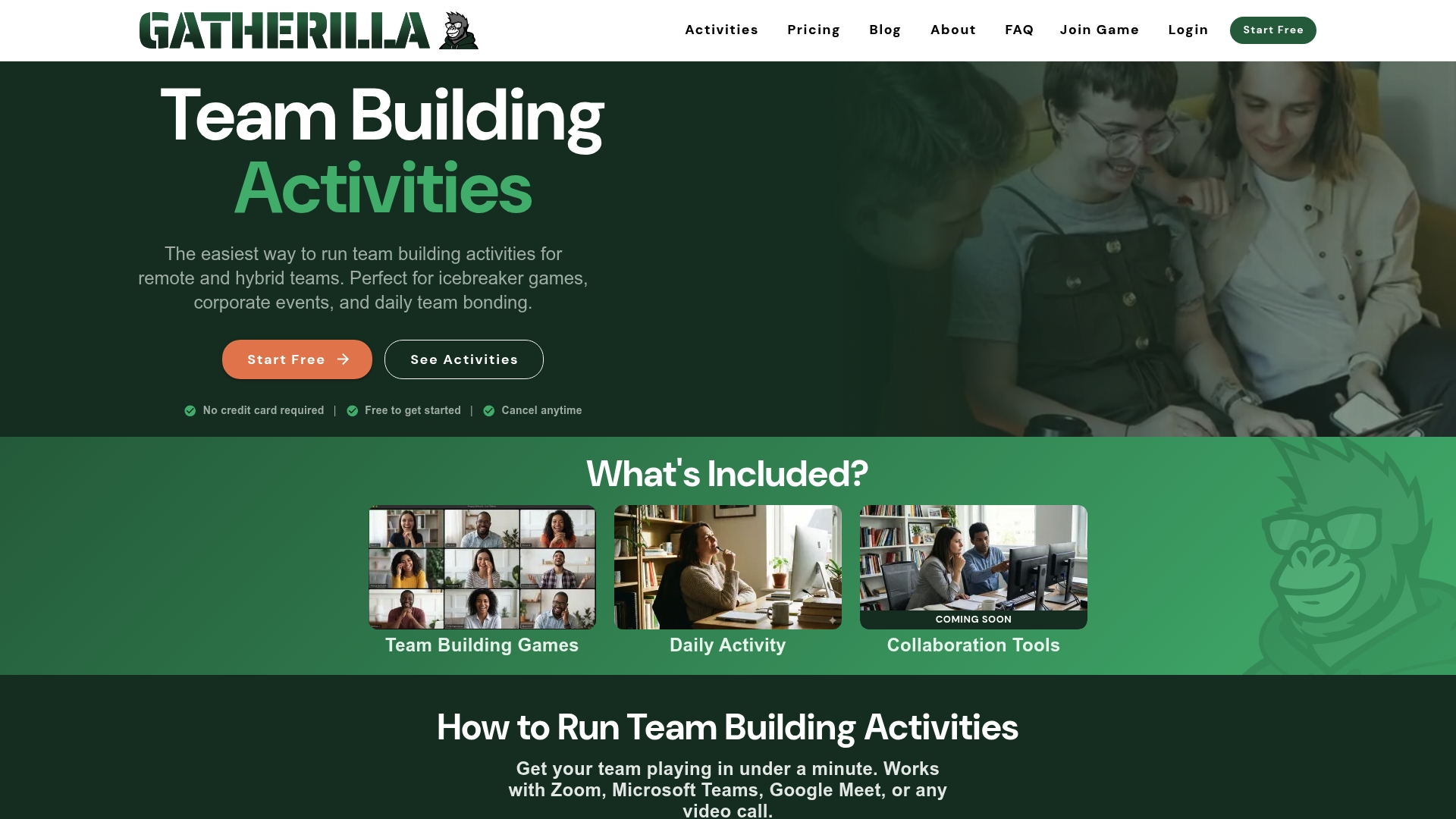
If you want to see how it feels in a real meeting, start from the Gatherilla homepage and open a game before your next stand-up.
Our view: small and daily beats big and rare
We build Gatherilla around a simple belief: connection on a remote or hybrid team is a habit, not an event. A quarterly offsite is great, but the relationships that make code review honest and incident calls calm are built in two-minute moments, repeated.
That is why we focus on zero-preparation games that run in a browser, with no downloads and no accounts required to join. If a facilitator has to spend an hour preparing, the icebreaker will not survive the next busy sprint. If everyone can join from a link in ten seconds, it will.
For developer teams specifically, we would start with the daily challenge as a warm-up before stand-up, use a short multiplayer game when a meeting opens, and keep the deeper questions for small groups. Recognition between peers, tied to your company values, then turns light fun into something the team actually values.
Thomas
FAQ
What are some good icebreakers for engineers?
Choose prompts with a story or a technical hook: the bug that taught you the most, the tool you would delete, the keyboard shortcut you use constantly, or how you use an AI coding assistant. Keep each to a few minutes and let people pass.
How long should a developer icebreaker take?
Three to five minutes for most meetings, and 30 to 60 seconds for a daily stand-up. Longer activities like a team timeline, which takes about 15 minutes, belong in kickoffs and offsites.
How do I run an icebreaker in a hybrid meeting?
Give everyone the same way to respond. Have people in the room use their own laptops or phones, just like remote colleagues, and use chat, polls or a browser game. Avoid physical activities that only the people in the room can do.
What icebreakers work for a new developer’s first week?
Use small groups and light, work-style questions such as favorite editor setup or preferred way to get feedback. Rotating openers at regular team meetings, as Mattermost does, let the new hire learn the team’s style before they have to share much.
Sources
- Icebreaker Activities | Atlassian Team Playbook
- Team Connectedness | Atlassian Team Playbook
- 7 icebreaker games to help your team build authentic connections | Atlassian
- 40 Ice Breakers & Energisers for Software Engineering Teams | The Engineering Manager
- 100 Icebreaker Questions for Product and Dev Teams | Centercode
- Speed networking questions engineers want to answer | EngineeringLeaders.io
- 60 Fun And Exciting Virtual Icebreakers For Remote Work | Science of People
- Onboarding as a remote engineer with Mattermost | Mattermost
- How to Build Team Trust: Practical Steps for Leaders | Christian DISC